
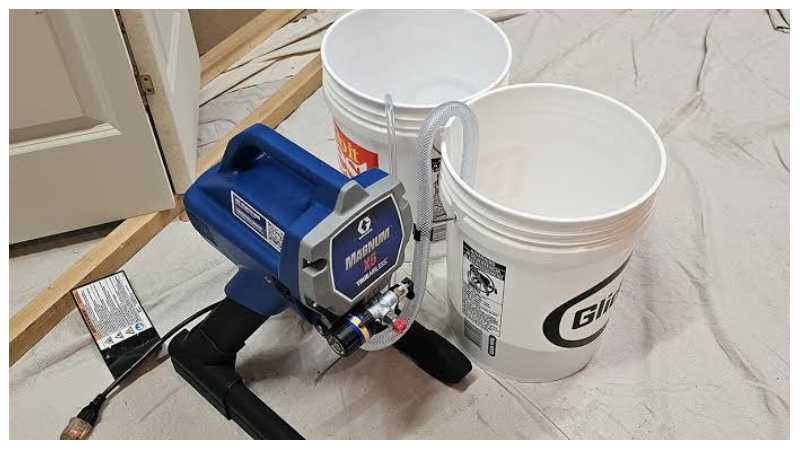
Every comparison of these machines runs through the same specification table and arrives at the same conclusion, which is that the more expensive one is better. That is true and not very useful, because it does not tell you which one you should buy.
The more useful question is how much spraying you actually do in a year. That single number resolves this decision better than any feature list, and it is the question almost nobody asks before buying.
The Pairing Nobody Explains
First, a structural point that clears up a lot of confusion.
The X5 and the LTS 15 are closely related machines. So are the X7 and the LTS 17. The Magnum names are the versions sold through general retail; the LTS designation appears on versions sold through paint stores and distribution. Within each pair, the machines share a great deal.
That is why parts listings often cover them together. The breakdowns for the X5 and LTS 15 diagram and parts list are combined for precisely this reason, as are the X7 and LTS 17 diagram and parts listings.
The practical takeaway: if you are comparing an X5 against an LTS 15, you are comparing two versions of essentially the same machine. The real decision is between the smaller pair and the larger pair.
What Actually Separates Them
Strip away the marketing and three things differ in ways that matter.
Output. The X5 delivers roughly 0.27 gallons per minute. The X7 delivers roughly 0.31. That sounds like a small gap and it is, but it determines the next point.
Maximum tip size. This follows directly from output. The X7 supports a slightly larger tip than the X5. Neither supports a large tip in contractor terms. This is the specification that most often gets ignored and most often causes problems.
Annual gallon rating. This is the number worth paying attention to, and it is the one that gets left out of comparisons. Graco rates these machines for a recommended annual volume, and that rating reflects what the pump and motor are built to sustain over a year.
The third one is the decision maker, and it is the one this article is really about.
The Framework: Count Your Gallons
Instead of comparing features, estimate how much material you will spray in a year. Then match the machine to that number.
Under about 50 gallons a year. This is the homeowner and occasional user range. A few rooms, a fence, a deck, some furniture. Either of these machines handles it comfortably, and the smaller pair is the sensible purchase. Buying the larger machine for this volume means paying for capacity you will not use.
50 to 125 gallons a year. The serious do-it-yourself range, or a very light side business. This is where the larger pair starts to earn its price, because you are approaching the comfortable limit of the smaller one.
125 to 300 gallons a year. You have outgrown this entire category. This is where a 390 or a similar entry level contractor machine becomes the right answer, and continuing with a Magnum means replacing pumps more often than the price difference justifies.
Above 300 gallons a year. Contractor equipment, without qualification. A 395, 490 or 495 depending on tip size and whether you run more than one gun.
That framework is more honest than a feature comparison because it accounts for the thing that actually destroys these machines, which is sustained use beyond what they were designed for.
Why Over-Buying and Under-Buying Both Cost Money
Both errors are expensive, in different ways.
Under-buying means running a machine past its intended duty. The pump wears quickly, you replace it, and then you replace it again. Two pump replacements on a Magnum approach the price of the next machine up, and you still have the smaller machine at the end of it.
The symptom pattern to watch for: a machine that needed a pump sooner than you expected, and then needed attention again not long after. That is not a defective machine. That is a machine telling you about your volume.
Over-buying is less damaging but still wasteful. A machine bought for occasional use that sits for eleven months of the year has a different problem, which is that sitting is hard on sprayers. Material left in the fluid section, seals drying out, a pump that has not moved in a season. The cost of over-buying is not the purchase price alone, it is maintaining capacity you are not amortizing.
If you genuinely spray twice a year, the smaller machine looked after properly will serve you better than the larger one neglected.
The Tip Size Trap
This causes more trouble than any other single thing on these machines, so it is worth being explicit.
Both the X5 and the X7 have a maximum tip size, and it is smaller than people expect. Fitting a tip above that limit does not give you more output. It gives you a starved pattern with heavy edges and tails, because the machine cannot supply the volume the orifice is asking for.
That pattern looks exactly like a worn pump. It gets diagnosed as a worn pump regularly.
The reason people over-tip is understandable: they are spraying something thick, the pattern looks poor, and a bigger hole seems like the obvious answer. It is the wrong answer. The correct responses are to thin the material appropriately for the equipment, or to accept a slower job, or to use a machine with more output.
Before concluding anything about a pump on one of these machines, check the tip size against the machine’s rating. It is free and it resolves a surprising number of complaints.
What Wears, and What It Costs
The consumables are the same across both pairs, which simplifies ownership.
Tips. The highest frequency item and the first thing to change when a pattern goes wrong.
Filters. The inlet screen and the gun filter. Cheap, routinely neglected, and responsible for symptoms that look mechanical.
Pump repair kits. The main scheduled wear item. The symptom is fluid appearing at the pump throat.
Hose. These machines ship with a modest length, and people add to it. Adding length costs pressure at the gun, and on machines with this much output, there is not a lot of margin to give away.
Suction tube and inlet. Bent, crushed or clogged. Common on machines that get moved around in a truck bed.
The useful fact: these are all inexpensive, and together they account for most of what goes wrong. The expensive failures on these machines are usually downstream of a neglected cheap part.
Storage Is the Thing Most Owners Get Wrong
For the occasional user in particular, the way the machine is stored matters more than the way it is used.
A Magnum that gets used for one weekend a year spends 363 days doing nothing, and what it does during those days determines whether it works next time. Material left in the fluid section cures. Seals dry out. The pump sticks.
The flush discipline on these machines is therefore not about this job, it is about the next one. Flush thoroughly, run the appropriate storage fluid through if you are putting it away for a season, and store it somewhere that does not freeze.
A machine that fails to start after a winter in an unheated garage with water in it has not developed a fault. It has been damaged by storage, and that damage is preventable with twenty minutes of attention at the end of the previous job.
If You Already Own One
Most people reading a comparison like this already own one of these machines and are deciding whether to keep it. The questions worth asking:
Has it needed a pump? If yes, and sooner than a few years in, look at your annual volume and your tip size before buying another pump.
Is the work changing? If the jobs are getting larger or the coatings heavier, the machine will tell you before long. Replacing pumps on an undersized machine is a slow route to the same decision.
Is it being stored properly? If the trouble appears at the start of each season rather than during use, the issue is storage, not capacity, and that is fixable without spending anything.
What tip are you running? Honestly the first thing to check, and the answer is sometimes the whole explanation.
The Summary
The X5 and LTS 15 are one machine in two liveries. So are the X7 and LTS 17. The real choice is between the smaller pair and the larger pair, and the right way to make it is by annual gallons rather than by feature list.
Under 50 gallons a year, buy the smaller pair and look after it. Approaching 125, buy the larger pair. Past that, this is not the right category and continuing in it will cost more in pumps than the correct machine would have cost outright.
And whichever you own, check the tip size before you blame the pump. That one habit prevents most of the unnecessary parts spending in this entire product class.